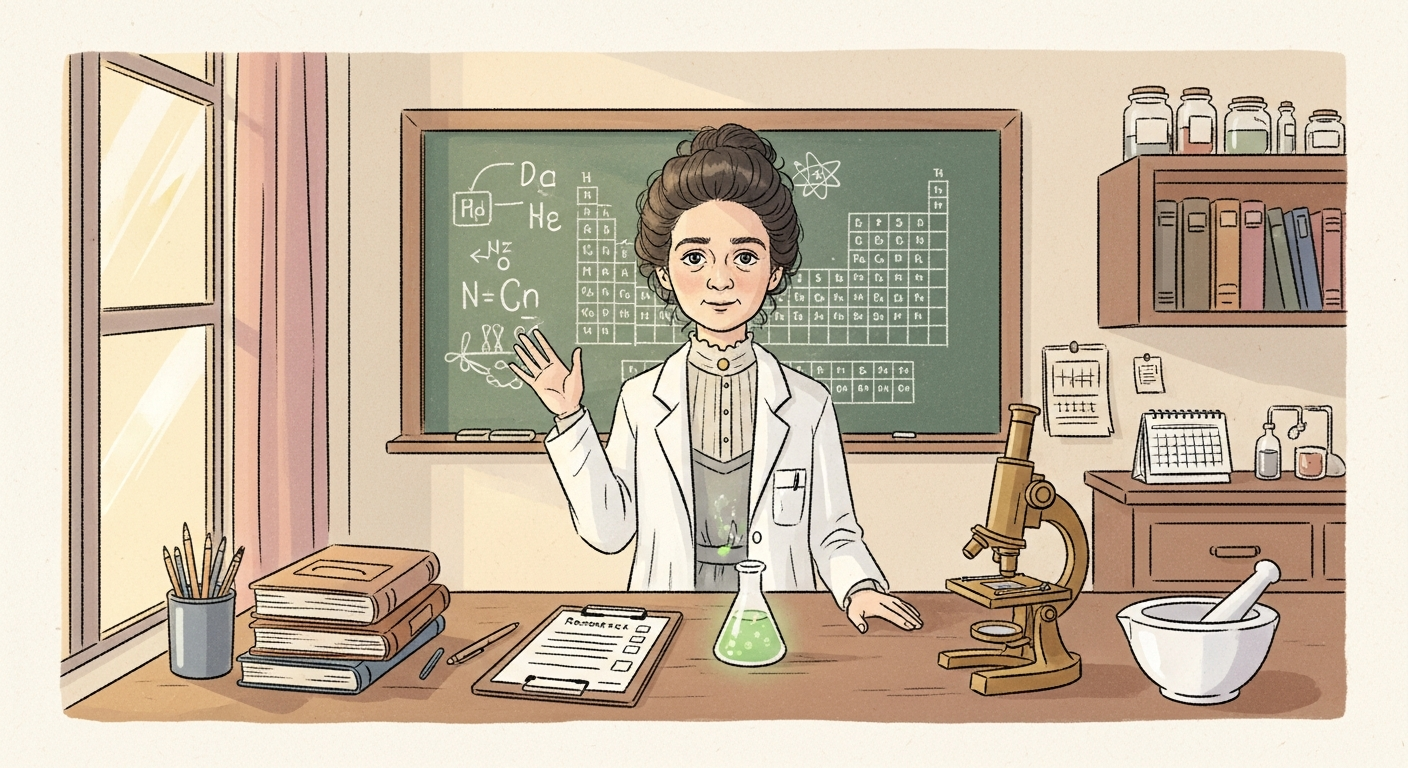
Hello. I'm Marie.
Come build your research skills.
A small illustrated guide for anyone who runs a research programme, writes papers, and responds to peer review. Take the tour with me. Each station is about a coffee-break long. By the end, you'll have a written skill you can hand to Claude and run on Monday morning.
Five stations, one builder bench.
Five short stations get you fluent in the way of thinking. The builder bench at the end lets you actually write your first research skill. Pick a station, or start at the beginning with me.
Spot the skill-shape
Some research tasks are skill-shaped, most aren't. Learn to tell the difference in ten seconds.
Station 02Find the cut lines
The research production line is six output forms in a trench coat. Cut where the form changes.
Station 03Write data, not vibes
"A literature review" is a vibe. A list of foundational works, approach families, and open gaps is a shape.
Station 04Compress the judgment
"Review this paper" is one verb in your head. It's six numbered moves on the page. Write the moves down.
Station 05The joints are where stacks fail
Two skills with mismatched schemas don't click together. Design the joint, not just the nodes.
Studio 01Write your first skill
Fill in seven small fields and walk out with a real research skill, ready to hand to Claude. Autosaves in your browser.
A paper isn't one big mess.
It's a small number of sub-tasks that each have a clean shape if you bother to look. Decompose them, write each as a skill, and the production line that takes you from a vague topic to a published paper becomes legible — and re-runnable.
The paper assembles itself by composition.
The best research skills are the boring ones. The ones a careful postdoc could run on your data and produce the same shape of output every time. If your skill is dramatic or surprising, something is wrong. Boring is the goal.
Where this actually applies.
Not abstract. The six places research actually lives, in the order they normally chain from a vague topic to a published paper.
Literature surveys
Map the prior art: foundational works, approach families, state of the art, open gaps.
Hypotheses
Convert a gap into a falsifiable claim with a pre-registered predicted signature.
Experimental design
Platform, materials, light source, noise budget, positive and negative controls.
Data analysis
Fit a physical model, propagate error, audit residuals, flag the structured ones.
Manuscripts & figures
Self-contained captions, IMRaD prose, every figure tells one story in three seconds.
Peer-review responses
Classify each comment substantive / cosmetic / wrong, then respond accordingly.
About 25 minutes if you walk through stations 1-5. Add ~25 minutes more for the builder studio at the end. You can split it across days. The workshop doesn't close.